
 Asaf Matatyaou

 5 min read
What is Agentic AI? (And Why It's Not Just "Better Automation")
Every vendor claims they have "AI-powered" solutions. So what makes agentic AI actually different?
Traditional automation follows rigid rules: "If packet loss exceeds 2%, send alert." It executes predefined workflows but can't adapt to novel scenarios or distinguish between a minor blip and a cascading failure.
Agentic AI deploys specialized AI agents that work collaboratively, like a digital operations team:
-
Monitoring agents learn normal baseline behavior across millions of data points, spotting anomalies that humans would miss
-
Diagnostic agents reason through complex multi-source troubleshooting in seconds, correlating RF data, environmental factors, and configuration changes
-
Planning agents predict future degradation patterns and recommend preventive action
-
Orchestration agents coordinate system-wide responses without human intervention
The difference: Automation executes what you program. Agentic AI reasons through what you didn't anticipate.
For broadband network operators overwhelmed by 10,000 daily alerts, where only 10 actually matter, this distinction is everything.
Why Yesterday’s Tools Don’t Deliver Anymore
Cable operators traditionally used manual sweep-and-balance techniques, portable spectrum meters, and truck rolls to resolve RF issues. That made sense when the return path handled only a few SC-QAM channels in the 3.2 to 6.4 MHz range.
But now, DOCSIS network operators face:
-
Spectrum explosion: High-split upgrades (85/204 MHz) introduce FM and VHF interferers that legacy bands have never touched.
-
Channel density: A 192 MHz OFDMA block holds roughly 8,000 subcarriers. Across hundreds of R-PHY ports, managing this level of subcarrier density makes manual quality assurance impossible.
-
Subscriber demand: With symmetrical 1 Gbps+ plans, even a brief burst of uncorrectable errors can disrupt streaming services.
-
OPEX pressure: Truck rolls cost an average of $150 to $600. In some cases, they exceed $1,000 with overtime.
-
Too many variables: Modern broadband networks now contain too many moving elements for human management alone.
Telco operators managing PON networks face parallel challenges: monitoring thousands of ONTs across wavelength-division multiplexed fiber, detecting individual subscriber degradation in shared-bandwidth architectures, and maintaining service quality as capacity demands grow.
Whether DOCSIS or PON, modern broadband networks share common operational pressures, including subscriber expectations for reliability, capacity complexity, and the impracticality of manual management at scale
DOCSIS 3.1 and 4.0: Built for Self-Healing Intelligence
DOCSIS 3.1 and 4.0 introduce critical tools that enable broadband networks to manage themselves effectively. These include:
- Dynamic Upstream Modulation (DUM) for SC-QAM
- Adaptive profile selection for OFDM and OFDMA at each cable modem
- Adjustable modulation profiles based on per-channel conditions
- Burst noise mitigation to counter impulse noise events
- Partial bonding between OFDM/A and SC-QAM paths
Used correctly, these capabilities allow broadband operators to stop worrying about low MER, degraded SNR, imbalance, impulse noise, or hidden impairments. The network automatically responds and recovers. Most issues get resolved before the operator or subscriber even becomes aware of them.
The Five Layers of Defense in a Reactive DOCSIS Network
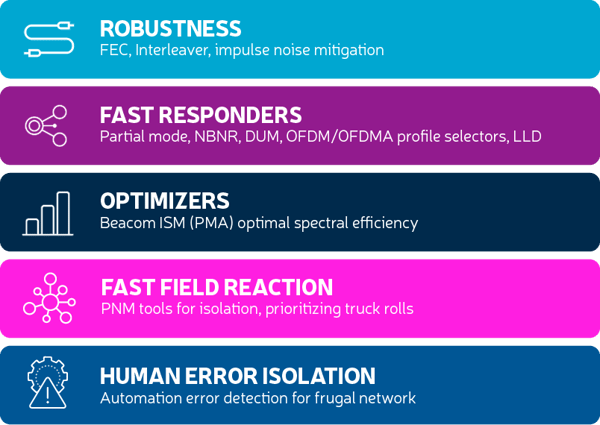
- Robustness: Real-Time Data Protection with FEC and Noise Mitigation
- The Robustness layer operates at the data path level. It protects against bit errors through forward error correction, interleaving, and impulse-noise suppression. These are real-time defenses no human could execute quickly enough.
- Fast Responders: Adaptive Modulation and Impairment Recovery
- Fast Responders operate at the control plane. This layer includes Partial Mode, DUM, Narrowband Noise Reduction (NBNR), and dynamic selection of OFDM/OFDMA profiles. These tools mitigate impairments in seconds, avoiding packet loss, and reducing the impact on latency-sensitive services.
- Optimizers: Network Capacity Restoration and SLA Assurance
- The Optimizers activate once the transient noise event has cleared and Fast Responders have stabilized the network. They restore full throughput by reversing temporary workarounds and rebalancing the spectrum to optimal efficiency. Without this layer, the network remains in a degraded "safe mode" long after the original impairment is resolved, leading to congestion and missed SLA targets.
- Fast Field Reaction: Precision Troubleshooting When Automation Falls Short
- Fast Field Reaction focuses on guided intervention. When automated layers are insufficient, Proactive Network Maintenance (PNM) tools isolate the root cause of service degradation, pinpointing exactly where to act.
- Strategic Integrity: Human Error Isolation & Predictive Planning
- This final layer governs the health of the entire system over time. It serves two critical functions:
- Risk Mitigation: It monitors scripts, configurations, and CI/CD workflows to prevent human-induced regressions or misconfigurations from undermining automation.
- Long-Term Foresight: It analyzes multi-week and multi-month trends to identify "slow-burn" suspects—minor degradations or capacity drifts that haven't triggered an alert yet but indicate future systemic failure. By flagging these early, it allows operators to optimize the network weeks before the customer ever feels an impact.
- This final layer governs the health of the entire system over time. It serves two critical functions:
What is the Operator's Role in the Era of AI-Powered Operations?
The last two layers still require manual decision-making when automated defense is insufficient. Field fixes, configuration updates, and capacity planning remain essential to operator responsibilities.
DOCSIS and PON network operators must monitor and address the following:
- Traffic congestion caused by subscriber growth or capacity degradation (upstream bandwidth contention in DOCSIS, wavelength saturation in PON)
- Severe MER/SNR drops (DOCSIS) or optical power budget degradation (PON) that reduce usable bandwidth
- Port congestion that prevents SLA fulfillment
- Legacy plant components (amps, filters) that block split upgrades
- Bugs or misconfigurations causing partial service
- Synchronization timing issues
- UCER events that automation cannot correct
Harmonic's cOS Central platform with SensAI operationalizes this vision through a multi-agent AI architecture, deploying specialized agents to monitor, diagnose, and orchestrate self-healing across the entire broadband infrastructure. SensAI acts as an intelligent assistant for decision-making, helping operators prioritize actions, correlate complex data sources, and determine optimal responses when automation alone is insufficient.
Proactive Network Maintenance Today: Not Just Proactive, but Surgical
PNM was initially viewed as a proactive maintenance tool. In a reactive network, however, it takes on a diagnostic role. Its purpose is to accurately and quickly identify root causes when automation is unable to resolve a fault, allowing field teams to respond only when necessary to the precise location of the fault.
What to Measure in a Self-Healing Network
Success is measured not by how many truck rolls are necessary but by how often they aren’t. Key KPIs include:
- Availability: Percentage of time modems stay online
- Serviceability: Time the network runs with low UCER
- Congestion: Time without clipping or overload
- Efficiency: Actual spectral use vs optimal
- Truck Roll Rate: Normalized dispatch frequency
The Path Forward: Let Your Network Heal Your Business
The broadband industry is shifting from reactive firefighting to intelligent, self-healing operations. Operators clinging to manual processes will watch OPEX spiral while competitors using AI-powered frameworks capture market share through superior reliability and lower costs.
Harmonic's five-layer frame spans the entire cOS Central platform ecosystem, turning HFC infrastructure into a self-managing system:
- Robustness prevents bit loss with Beacon ISM
- Fast Responders adapt instantly with PathFinder
- Optimizers maximize capacity and restore service quality
- PNM pinpoints field action when needed
- Strategic Integrity safeguards against misconfigurations and predicts future issues with SensAI
Traditional vs. AI-Powered Broadband Operations
Traditional approaches can't scale. The comparison is stark.
| Operational Aspect | Traditional Manual Operations | AI-Powered Self-Healing Networks |
| Issue Detection | Hours (manual monitoring, customer complaints) | Seconds (real-time AI monitoring) |
| Root Cause Analysis | Days (manual log correlation) | Minutes (automated multi-source analysis) |
| Network Coverage | <10% (known outages) | 100% (no missed incidents) |
| Network Coverage | DOCSIS only or PON only (siloed tools) | Unified platform across DOCSIS, PON, and hybrid networks |
| Engineering Focus | Reactive firefighting | Strategic optimization |
| Truck Roll Accuracy | 40% find no problem | +/- 95% precise dispatch |
| After-Hours Escalations | Constant interruptions | +/- 75% reduction |
| Operational Costs | Fixed/growing OPEX | Significant reduction |
| Subscriber Awareness | Complaints drive action | Issues resolved before impact |
| Team Capacity | +/- 50 incidents per engineer weekly | +/- 500+ incidents per engineer weekly |
Self-Healing Across DOCSIS and PON
While this article uses DOCSIS-specific examples for technical depth, these self-healing principles apply across both DOCSIS and PON broadband access technologies:
For Cable Operators with DOCSIS + PON (Hybrid Networks):
- Unified operations across DOCSIS and PON infrastructure during technology transitions
- Cross-technology visibility and correlation (CMTS data + OLT data in a single platform)
- Consistent AI workflows regardless of the access layer
- Operational continuity as the network evolves from DOCSIS to PON
For Pure-PON Operators (Telco):
- OLT telemetry integration (parallel to CMTS telemetry approach)
- Wavelength management and fiber performance monitoring
- ONT status tracking and automated troubleshooting (parallel to cable modem diagnostics)
- Same AI-powered multi-agent architecture, adapted to PON data sources
Harmonic's cOS Central platform with SensAI integrates with any DOCSIS or PON network technology. Your infrastructure choices shouldn't limit your operations capabilities, whether you're running:
- Cable networks: DOCSIS 3.1, DOCSIS 4.0, or DOCSIS-to-PON transitions
- Telco networks: XGS-PON, GPON, or other PON technologies
- Hybrid networks: DOCSIS + PON during infrastructure evolution
The strategic advantage: While competitors build vendor-specific operations tools, AI Operations (AIOps) that work across DOCSIS and PON provide operational consistency across your entire broadband infrastructure today and as technologies evolve.
The five-layer self-healing framework isn't technology-specific; it's a universal approach to broadband network intelligence. Whether operating DOCSIS networks, deploying PON infrastructure, or managing hybrid environments during technology transitions, the principles remain constant: Automate what machines do better, preserve what humans do best, and build operations that scale with network complexity.
Next in this series: How do operations teams actually work with AI agents day-to-day? From 10,000 alerts to 10 surgical actions, explore how agentic AI filters out noise and reveals the truth.
Explore: Harmonic's Central Platform with SensAI: Discover how the five-layer framework comes to life. Learn More →

Asaf Matatyaou
Senior Vice President, Product, Broadband Business




Featured Insights