




How Harmonic Delivered Flawless Streaming for the World's Biggest Live Sports Moments in Q1 2026
Live sports streaming is the most unforgiving frontier in media technology. There are no retakes, no pause buttons, and no second chances. When tens of millions of fans hit play at the same moment — expecting crystal-clear video, instant startup, and zero buffering — the margin for error is exactly zero.
At Harmonic, we have made that margin our standard. Across Super Bowl LX, the 2026 Milano Cortina Winter Olympics, March Madness, the NBA All-Star Weekend, and a packed calendar of Hockey, Baseball, and motorsport, our teams delivered 100% of uptime targets across every event. This post pulls back the curtain on exactly how we do it.
What follows covers four pillars that, together, make flawless live sports delivery possible:
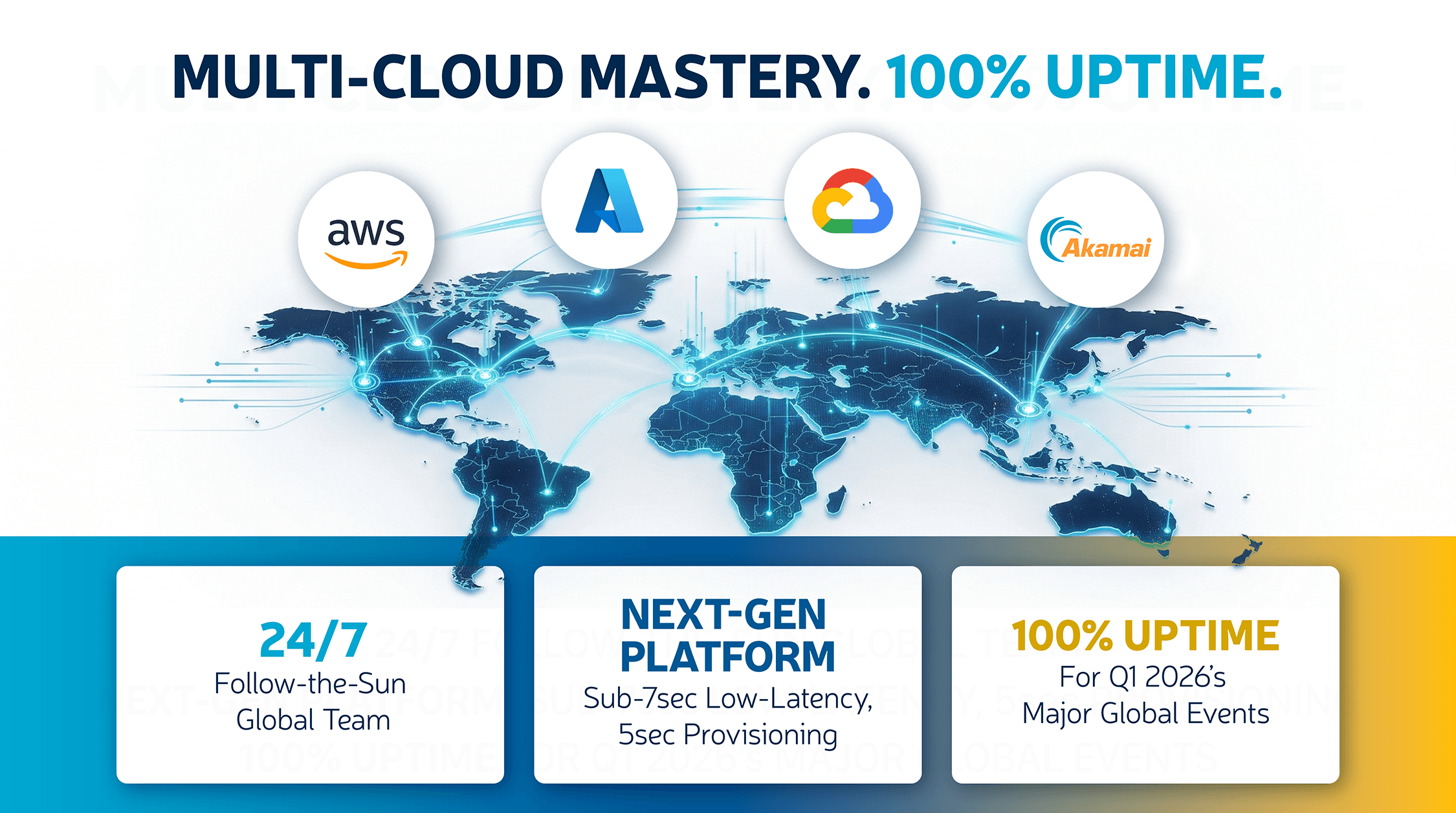
- A multi-cloud platform built for peak-of-peak demand — VOS®360 Media SaaS and MSL5 running across AWS, Azure, GCP, and Akamai Cloud
- A globally distributed, follow-the-sun DevOps team — 100+ veteran engineers across the US, Canada, Spain, and Hong Kong, on watch 24/7/365
- Monitor by anticipation — predictive analytics, automated alerting, and self-healing remediation playbooks that act before viewers ever notice a problem
- Eight years of continuously improving processes — from capacity planning to chaos testing to post-event retrospectives, a true CI/CD culture applied to operations itself
The Platform: Multi-Cloud, Built for the Moments That Cannot Fail
Harmonic's VOS360 Media SaaS and Akamai Media Services Live 5 (MSL5) — the next-generation streaming platform jointly developed with Akamai and powered by Harmonic's cloud-native technology — form the foundation of live sports delivery at the highest tier. These are not general-purpose streaming tools adapted for sports. They were engineered specifically for the demands of live events: elastic real-time scaling, geo-redundant architecture with seamless failover, sub-7-second low-latency HLS delivery, and the ability to absorb sudden, massive audience spikes without degradation.
A critical and often underappreciated differentiator is our multi-cloud strategy. Harmonic's DevOps team carries deep hands-on expertise across AWS, Azure, GCP, and Akamai Cloud. This is not a checkbox — it means we can deploy workloads on the cloud infrastructure that best matches each customer's needs, route around regional cloud issues in real time, and avoid the single-cloud concentration risk that can result in catastrophic outage during major events.
The Team: Global, Veteran, and Always On
Technology platforms can be built. The institutional knowledge to operate them under pressure cannot be purchased off a shelf — it has to be earned. Harmonic's DevOps organization represents over eight years of accumulated operational intelligence, embodied in a team of more than 100 veteran engineers distributed across strategic hubs in the United States, Canada, Spain, and Hong Kong.
This geographic distribution is deliberate operational design. Follow-the-sun coverage means that for any live sports event anywhere in the world — whether it tips off at noon Eastern or kicks off at midnight Central European Time — there is a fully staffed, fully awake team of specialists monitoring and ready to engage.
The team brings genuine multi-cloud depth: engineers who have worked through real incidents on AWS, Azure, GCP, and Akamai, who understand the nuances of each platform's behavior under load, and who can make rapid, confident decisions when it matters. This is the human infrastructure that makes the technical infrastructure reliable.
Monitor by Anticipation: Fixing Problems Before They Happen
Traditional operations monitoring is reactive: something goes wrong, an alert fires, a human responds. At the scale and consequence level of live sports streaming, reactive is not good enough.
Harmonic's DevOps team has built what we call a "monitor by anticipation" discipline. Using predictive analytics continuously applied to platform telemetry, our systems are not looking for current problems — they are identifying the early signatures of problems that have not happened yet. When a resource utilization pattern, a latency trend, or an ingestion anomaly begins to diverge from established baselines, automated alerting surfaces it immediately — often minutes before it would manifest as a viewer-visible issue.
From there, automated incident triage classifies the event and triggers the appropriate remediation playbook. In many cases, the system self-heals entirely: a resource is scaled, a route is switched, a service is restarted — all before a human engineer has been paged. For events that do require human judgment, the escalation path is pre-defined, practiced, and fast.
The result is that the overwhelming majority of potential disruptions are resolved in the background, invisibly, while the game plays on. This is not luck. It is the outcome of continuous investment in automation, tooling, and the relentless retrospective culture that sharpens both.
Advanced Monitoring, Predictive Analytics, and Automated Remediation For live events, detecting a problem is only valuable if you can act on it faster than any viewer notices. Harmonic's DevOps team has built and continuously matured a sophisticated operations toolchain anchored in predictive analytics, automated alerting, and intelligent incident triage. When anomalies emerge, rapid machine analysis is conducted to determine the appropriate action to take. When very rapid action is required automated remediation executes and resolves the issue before a human engineer has even opened a ticket. This combination of prediction, detection, and automation compresses the mean time to resolution to the point where most potential disruptions are resolved in the background, invisibly, while the game plays on.
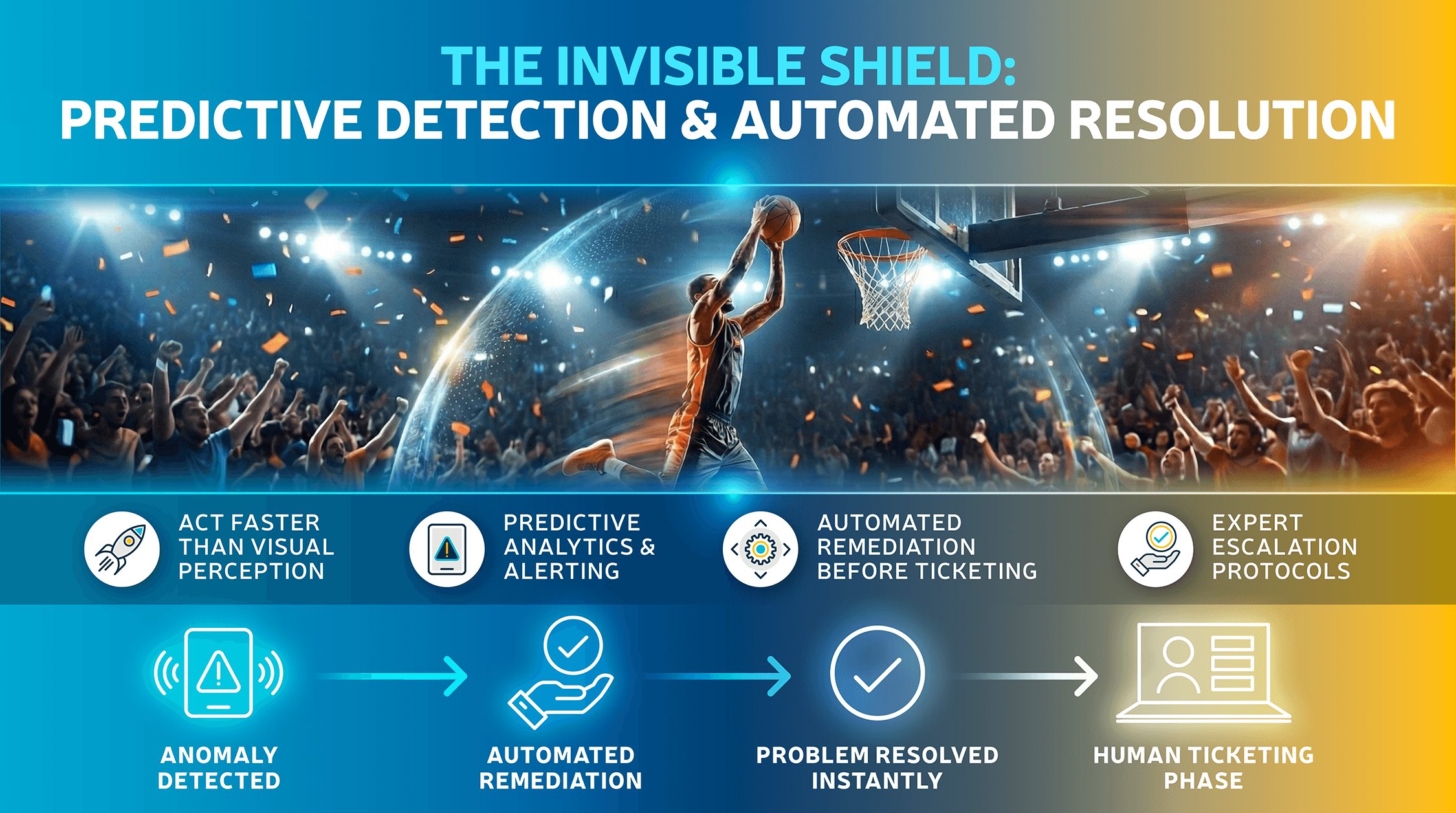
Rapid Incident and Escalation Protocols For the rare cases where human judgment is needed, Harmonic's incident and escalation protocols are equally well-rehearsed. Clear escalation paths, pre-defined communication channels, and experienced personnel with decision-making authority at every tier mean that the team can mobilize rapidly and coordinate across time zones without confusion or delay. Expert developers can be reached and join the incident team in minutes if required.
A Day in the Life: Inside a Super Bowl Deployment
To make this concrete, let us zoom in on what a Super Bowl deployment actually looks like for the Harmonic DevOps team. The game lasts four hours. The preparation takes weeks.
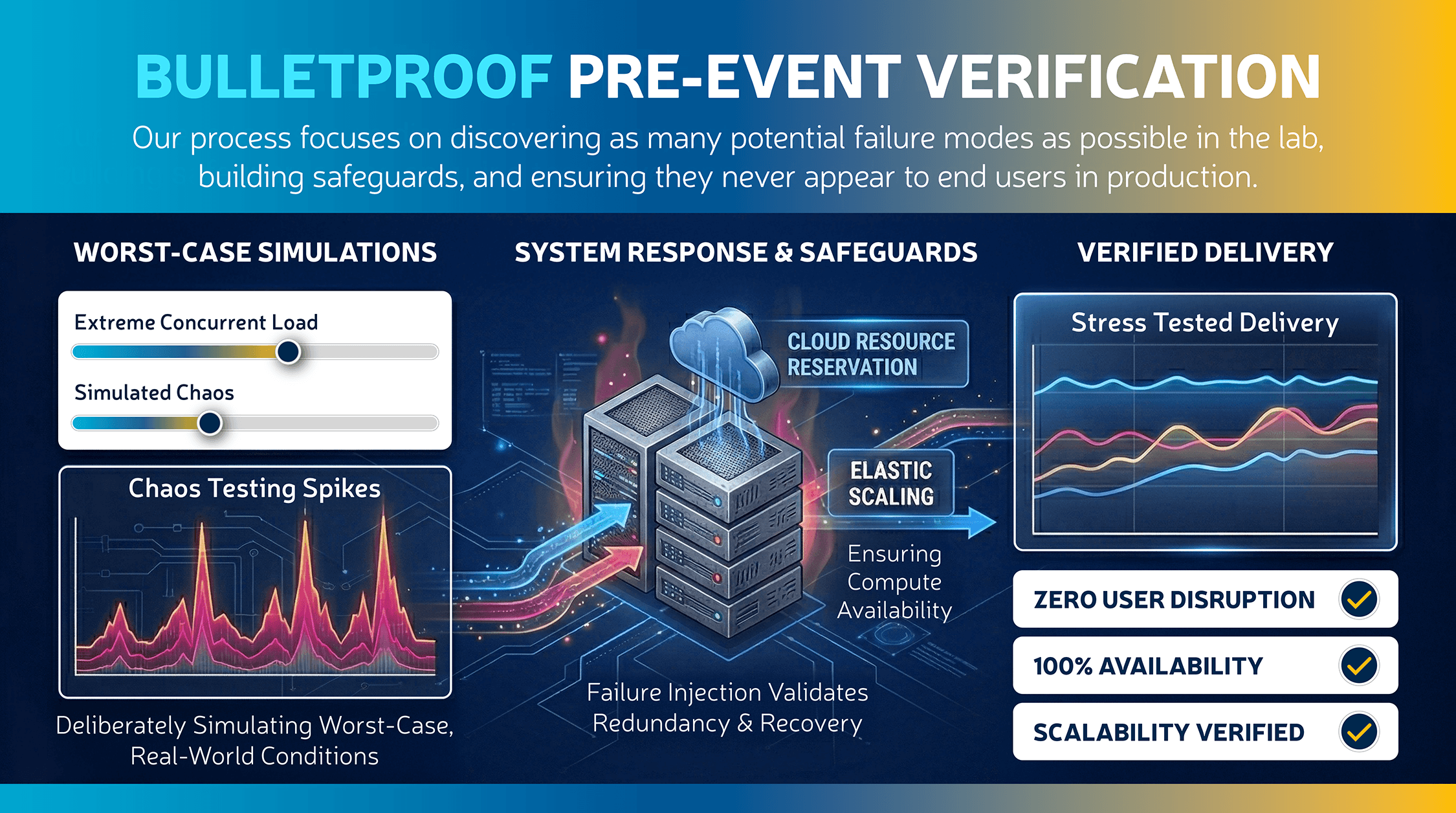
6–8 Weeks Out: Capacity Planning and Architecture Review The process begins long before kickoff. Working with customer operations and video engineering teams and Harmonic's video engineering organization, we develop detailed capacity models based on historical viewership data, projected growth, and worst-case concurrency scenarios. Cloud resources are reserved and pre-provisioned. Architecture is reviewed, multiple times, for any potential single points of failure. Nothing about Super Bowl Sunday should be a surprise.
3–4 Weeks Out: Stress Testing, Chaos Testing, and Dry Runs This is where we deliberately try to break things. Harmonic's DevOps and engineering teams execute comprehensive load testing that simulates peak-of-peak concurrency — not just viewer streams, but the simultaneous activity of large numbers of operations personnel managing the platform in real time. We run chaos tests that inject infrastructure failures mid-simulation to verify that automated failover and redundancy behave exactly as designed. We run scalability tests to confirm the platform can absorb sudden audience spikes of the magnitude a major sports event can produce. Critically, we conduct full end-to-end dry runs — complete MOPS (Method of Procedure) rehearsals — so that every team member knows exactly what they are doing on game day, and escalation protocols are muscle memory rather than reference material.
Game Week: Final Validation and Team Positioning In the final days before the event, we run final configuration validations, confirm monitoring dashboards are calibrated to event-specific thresholds, and ensure all global hub teams are briefed and synchronized. On-call rotations are confirmed. Communication bridges are established. Escalation contacts — across Harmonic, cloud providers, and customer operations — are verified.
Game Day: Active Watch, Real-Time Analytics, and Immediate Response On the day of the event global engineers across our US, Canada, Spain, and Hong Kong hubs watch real-time monitoring dashboards covering our infrastructure and software stack including ingest, transcoding, packaging, origin and end-user QoE metrics. We are observing simultaneous streams being encoded, packaged, and delivered across multiple clouds to dozens of device types, at bitrates ranging from mobile HD through full UHD with HDR and Dolby Atmos audio.
Predictive analytics run continuously. Every metric — from stream startup times to rebuffering ratios to encoding latency — is measured in real time and compared against event-specific baselines. AI-assisted log analysis surfaces anomalies at the speed of data, not the speed of human review. When something deviates, the automated response system engages immediately. Human engineers are already watching the same signal and ready to act within seconds if needed.
The Super Bowl represents one of the single highest-density moments of concurrent streaming demand in the calendar year. The combination of platform scale, multi-cloud flexibility, and real-time operational vigilance means that when millions of viewers are all watching the same play at the same moment, the infrastructure handles it without a ripple.
Post-Event: Retrospective and Continuous Improvement Once the final whistle blows, the work is not done. Harmonic's DevOps team conducts thorough post-event retrospectives examining every major alert, every escalation, and every metric deviation across the event window. Findings feed directly back into playbook improvements, automation enhancements, capacity model refinements, and testing protocols. This is true CI/CD applied not just to software, but to operations itself — every event makes the next one better.
The 2026 Season: Results Across Every Major Event
The methodology described above scaled across the full breadth of the 2026 sports calendar.
The 2026 Milano Cortina Winter Olympics was among the most complex multi-customer deployments we have executed. Multiple broadcasters and streaming platforms ran simultaneously on both VOS360 and MSL5, across hundreds of competition events spanning two weeks, multiple time zones, and a vast array of broadcast and streaming configurations. Every day presented a new slate of live events with its own peak demand profile. The entire period was delivered without incident.
Super Bowl LX, March Madness, NBA All-Star Weekend, NHL Hockey, Major League Baseball, and high-performance motorsport each brought distinct operational challenges — rapid scheduling changes, overtime scenarios, multi-concurrent-game situations, and variable audience sizes. Across all of them, the result was the same: 100% of uptime targets met.
The Fan Experience: Where It All Shows Up
All of this operational discipline ultimately has one purpose: the fan experience. Across every event, tens of millions of viewers on dozens of device types received:
- Outstanding video and audio quality — from HD to UHD with HDR and immersive audio formats including Dolby Atmos
- Low latency — keeping streaming audiences close to the live action, with end-to-end delivery in the low single-digit seconds
- Very low rebuffering rates — the stall-and-spin moments that break the spell of live sports, eliminated
- Fast startup times — fans in the game the instant they press play
- Very low video playback failure rates — reflecting end-to-end platform resilience at every layer
The Bottom Line
What makes Harmonic's live sports delivery different is not any single technology or any single process. It is the combination: a multi-cloud platform designed for peak-of-peak demand, a globally distributed team of veterans who are always on and always watching, a monitor-by-anticipation discipline that acts before problems become visible, and eight years of continuous operational improvement that makes every event a building block for the next.
When the world is watching, nothing goes wrong. In 2026, we have been delivering on that promise — across every event, every stream, every viewer, every time.