







Part 1: Upcoming C-BAND Reclaim & What to Know About It
The uncertainty of Upper C-band was top of mind for many at NAB ’26. Having transitioned off Lower C-band (3.7-3.98 GHz) during 2020 to 2023, broadcast and cable networks are faced with the reality that there may be an even more impactful change ahead. During Lower C-band, Harmonic conducted the two largest technology refreshes with each of the satellite operators.
With the reclamation of the Upper C-band (3.98-4.2 GHz) ahead of us, it’s critical to understand:
-
How this transition will be different
-
What alternative solutions have been proposed to ensure video delivery
-
How Harmonic is supporting these migrations.
The Lower C-band auction and subsequent transition were extremely successful for all involved. The auction raised $81.1B for the US Treasury. The fixed satellite operators (e.g. SES, Intelsat) collectively received $9.7B in incentive payments to accelerate the Lower C-band clearing. Broadcasters, Programmers and Cable TV Operators benefited from significant infrastructure upgrades in the form of encoding, modulation, distribution, and edge IRD equipment. Wireless Operators gained access to the C-band spectrum, utilizing the frequency’s “sweet spot” to advance 5G technologies for consumers.
The One Big Beautiful Bill Act (OBBBA), passed by Congress in July 2025, accomplished two key objectives for the FCC. First, OBBBA restored the FCC’s auction authority for the remaining Upper C-band spectrum. Second, it mandated a minimum of 100 MHz of Upper C-band (from the 180 MHz remaining) be auctioned for flexible wireless use by July 2027. Minimum is the key word. It’s possible that the entire Upper C-band spectrum could be cleared. As a result, the Upper C-band auction has the potential to force a dramatic shift in how Broadcasters and Programmers approach distribution.
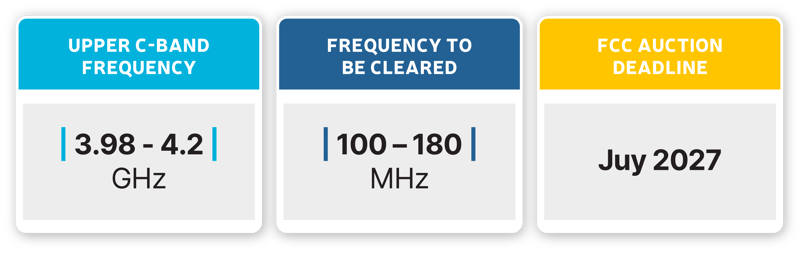
If more than 100 MHz is reclaimed, a satellite repack won’t keep users on the C-band. With that, all the stakeholders are investigating multiple alternative options including Ku-band satellite, private and public IP, CDN, and hybrid solutions. Any potential solution must prioritize the fundamental requirements for broadcast and cable networks: Latency, Availability, and Reach
How C-band is Used Today
Upper C-band is the delivery backbone for broadcast networks (e.g. ABC, CBS, Fox) and cable networks (e.g. CNN, ESPN, HGTV, etc.), sending programming to local affiliate stations or Multichannel Video Programming Distributors (MVPDs) (e.g. Comcast (Xfinity), Charter (Spectrum), DirecTV, Dish Network). This multi-step distribution process eventually reaches 120M (nearly all) households in the US.
For broadcast networks, satellite distribution is preferred because it addresses their biggest concerns:
- Latency,
- Availability,
- and Reach.
Similarly, cable networks have chosen C-band for distribution for its
-
Availability.
-
Reach.
C-band’s large satellite footprints can access thousands of MVPDs across North America and consistently provide the 99.999% required uptime availability. Cable networks deliver less live programming and therefore are less concerned with low & deterministic latency. A major benefit of satellite distribution for cable networks is the cost model. While satellite is by no means inexpensive, the “one-to-many” model allows cable networks to reach thousands of affiliates within a single transmission framework at a fixed price.
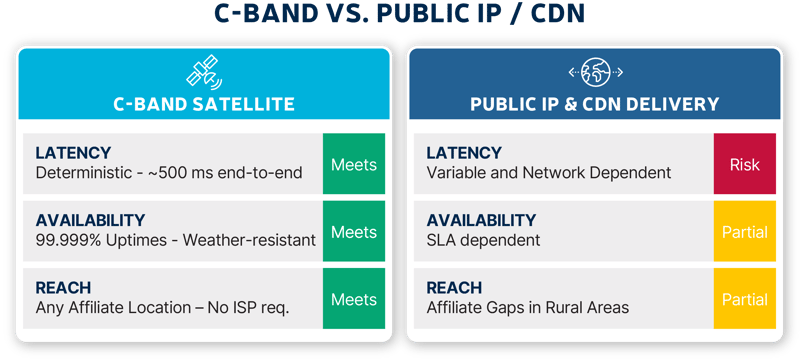
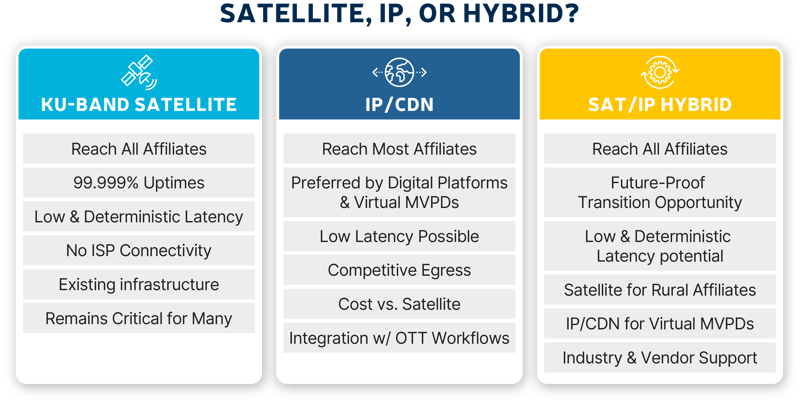
With Upper C-band’s future in jeopardy, the choice between satellite and alternative delivery methods (IP/Cloud) is becoming key. For both broadcast and cable networks, digital streaming platforms like Prime Video, Apple TV, Netflix, and virtual MVPDs like YouTube TV, Hulu+Live, FubuTV, and Sling TV make up a significant and growing portion of their business. Importantly, these digital platforms prefer to receive via IP.
On the other hand, broadcast and cable networks must continue to support affiliates where satellite is currently the only viable option. Whether in rural areas or in locations with limited network connectivity, these affiliates remain critical to the bottom line, and ceasing satellite delivery may be out of the question. As broadcast and cable networks enter the Upper C-band reallocation, they must decide whether to support distribution via satellite, IP/Cloud, or a mix of both.
Part 2: Upper C-band Replacement Solutions Under Consideration
IP Alternatives to Satellite
One alternate solution to C-band satellite is managed IP delivery through partner networks. Managed IP is billed as a reliable, low-latency, broadcast-quality alternative to satellite. If correct, this type of flexible and scalable distribution could provide freedoms not currently available with satellite. The biggest concerns for managed IP distribution are access, cost, and management, in particular of the “last mile”. While most major markets have the infrastructure to connect to partner networks, many rural areas don’t. Companies like LTN are making a concerted effort to reach as many endpoint locations as possible before the Upper C-band transition. Connecting to a managed IP network, however, can increase complexity. Once connected, broadcast and cable networks are responsible for integrating managed IP monitoring tools and workflows into existing broadcast management systems, adding an additional networking and operational burden. Finally, typical satellite distribution remains less expensive when delivering to thousands of endpoints or affiliates' headends. Those calculations change with fewer endpoints, and this metric will be a driving force behind distribution choice.
For cable networks, an idea that is gaining popularity is distribution via CDN. As CDNs are optimized to deliver OTT content to consumers at scale, they can also be used to deliver HTTP-based streams to affiliates. The driving force behind the move to CDN distribution is scalability and cost per GB. But there are tradeoffs. Compared with delivery over satellite or managed IP networks, CDN introduces higher and more variable latency, which can be a significant concern for broadcast workflows. As a result, CDN is less reliable for time-sensitive distribution. In contrast, when delivering to a smaller number of endpoints, broadcast and cable networks often prefer SRT distribution over public internet. While SRT delivery may carry a higher cost compared to CDN, it provides greater stability, lower latency and performance characteristics that more closely resemble that of satellite.
Ku-band Satellite Distribution
For broadcast and cable networks that want to stay on satellite, SES (the largest satellite operator in the world) has suggested “cross-strapping” today’s C-band satellite uplinks with updated Ku-band downlinks. This approach preserves the broad reach of C-band’s geographic coverage while improving affiliate downlink margins by leveraging updated Ku-band reception on existing antennas. Although antenna upgrades may be required to support Ku-band, a full replacement is not necessary. However, switching to Ku-band does come with trade-offs. SES has indicated that it could take up to 60 months to build and launch new Ku-band satellites, creating a longer transition timeline. Also, Ku-band interference, including rain fade and signal degradation which must be addressed. Ku-band has been widely used outside the US for distribution, and advanced protocols can assist with the potential weather impacts.
Augmented Ku-band with IP links for packet recovery could solve that problem. Based on the VSF TR-06-4 pt. 7 spec, RIST packet recovery resends missed or lost packets over a dedicated network to the satellite receiver or edge device. If needed, the RIST protocol is designed to support full terrestrial recovery over the same dedicated network until the satellite connection is restored. RIST packet recovery should provide C-Band-like reliability, overcoming end interference from atmospheric conditions as well as from bi-yearly solar outages.
For Upper C-band, recovery frameworks like RIST are prompting productive industry discussions around how to best deploy and scale dedicated recovery networks. Industry stakeholders hope the FCC’s final ruling will address the need for connectivity and its associated costs, enabling Ku-band packet recovery and laying the groundwork for full IP connectivity to all affiliates.
Satellite/IP Hybrid
A new idea from NAB ‘26 that is quickly becoming a front-runner to replace other Upper C-band solutions is Sat/IP hybrid distribution with deterministic switching. The rationale for the Sat/IP hybrid solution is that the Upper C-band transition cannot be solved with a single distribution technology. Instead, broadcast and cable networks can rely on a prioritized combination of low-latency sources (e.g. Ku-band satellite, Public and Private IP, 5G, or LEO) and deterministic switching to reach the same availability as C-band. Hybrid “gateway” devices would seamlessly switch between inputs to provide a packet- merged clean output with utmost flexibility at the edge. A powerful idea that has the potential to reshape the Upper C-band conversation. The obvious drawbacks of the Sat/IP hybrid approach are cost, complexity, and the potential of added latency. With C-band, a single solution provides the availability, latency, and reach needed to successfully reach any affiliate or endpoint. With Sat/IP hybrid, broadcast and cable networks must rely on several integrated distribution methods, running concurrently, to reach the same level of service. Additionally, input switching at the edge relies on internal buffering to align frames across inputs, trading latency for seamless switching.
Part 3: Harmonic’s solution to solve C-BAND reclamation
Harmonic played a major role before, during and after the Lower C-band reclamation, supplying advanced compression, distribution, and thousands of advanced satellite receiver IRDs that enabled operators to clear the spectrum within the FCC’s accelerated timelines. This technology suite, along with Harmonic’s full IRD management, entitlement and control system, allowed broadcast and cable networks to take advantage of state-of-the-art compression solutions for satellite distribution while providing customized outputs at each affiliate headend. The result was a successful satellite repack into the Upper C-band frequencies with minimal impact at the edge. Harmonic is now expanding this model to support the Upper C-band transition.
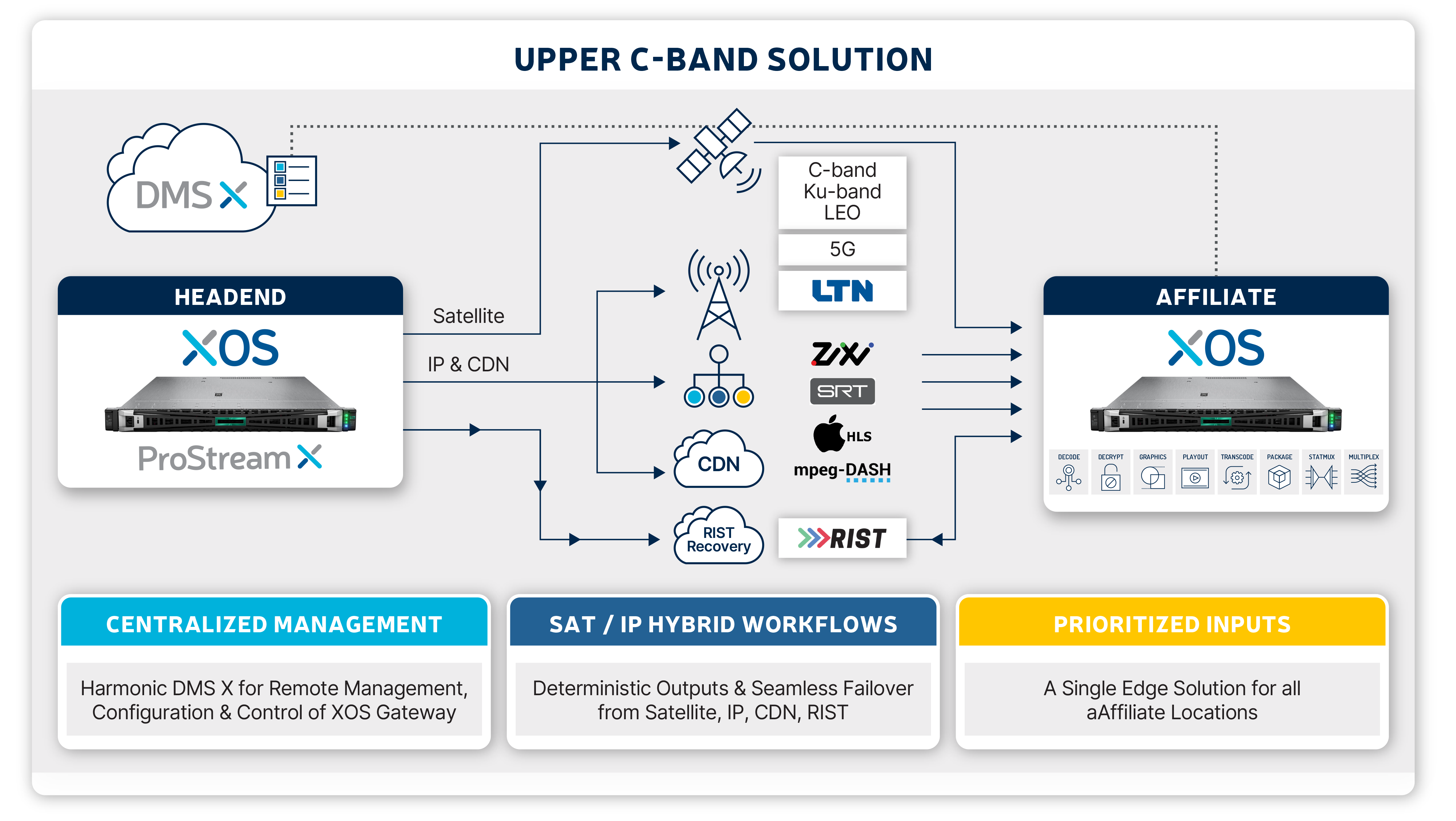
Harmonic’s Upper C-band solutions are based on the straightforward idea that our software-defined solutions, deployed at broadcast and cable network headends or in the cloud, combined with XOS Edge IRDs at the affiliate, can deliver any content, over any platform, to any affiliate.
Harmonic’s Upper C-band solution centers around the XOS Advanced Media Processor at the broadcast or cable headend and at the affiliate edge.
At the headend, XOS unifies fragmented infrastructure into a single headend software appliance. XOS combines premium video encoding, playout, encryption and delivery for broadcast and cable networks.
-
Powerful Compression: XOS features Harmonic’s Pure Compression Engine to deliver pristine video quality, up to 4K UHD HDR, with the lowest bitrates. Supporting the video codecs and formats needed by broadcast and cable networks.
-
Playout-to-delivery: XOS consolidates devices to combine playout, graphics insertion, ad insertion, encoding, packing, and delivery.
-
Flexible Deployment: Can be deployed on-prem, in the cloud, or in hybrid workflows.
At the edge, XOS combines the same “headend-in-a-box” features with customization at the edge, including localized playout, graphics and ad insertion, as well as supporting satellite, IP, and CDN inputs.
-
Headend-in-a-Box: XOS consolidates multiple edge processing devices into one box, including satellite IRDS, ad playout and graphics insertion, packaging, and distribution to external devices.
-
Edge Transcoding: XOS’ advanced transcoding allows broadcasters and programmers to customize output formats for each affiliate.
-
Low and Deterministic Latency: XOS has been successfully deployed for Primary Distribution of broadcast workflows and is field proven to ensure packet output is synchronized across all IRDs.
-
Future Proof for C-band: XOS supports both C-band and Ku-band satellite with RIST packet recovery, managed IP through partners like LTN and Zixi, CDN, and hybrid workflows, providing a powerful solution for the Upper C-band transition.
XOS is the backbone of a flexible distribution solution, built for scale and resilience, enabling uninterrupted delivery over satellite, IP, CDN, and hybrid workflows. Combined with our distribution management system, DMS-X, Harmonic ensures premium video quality, streamlined operations, remote edge device management, and content customization at the edge.
Multiple Input Options
Satellite remains critical for many. For broadcast and cable networks that require satellite distribution, the Harmonic XOS Ku-band + RIST solution utilizes the VSF TR-06-4 specification, embedding packet recovery into our award-winning primary distribution products, allowing for increased signal availability to match C-band.
For those looking for alternatives to satellite distribution, Harmonic supports multiple IP & CDN distribution options within XOS. Harmonic’s SRT delivery over public internet, dedicated fiber, or via our VOS360 platform has already successfully transitioned customers to IP delivery. Harmonic is CDN agnostic and can be used to deliver HLS or DASH streams from the cloud to our XOS edge IRDs across the globe.
Finally, XOS supports distribution through partner networks, enabling broadcast and cable networks to utilize existing low-latency networks as a managed IP distribution solution.
Harmonic has a long history of bringing innovative and flexible solutions to market. The prospect of leaving Upper C-band seems daunting, but Harmonic is hard at work developing next-generation distribution solutions. Whether Ku-band + RIST, managed IP through partners like LTN or Zixi, CDN, or Sat/Hybrid delivery, Harmonic’s primary distribution products are solving C-band.